Bring approved waste information, packaging, equipment, site responsibilities and acceptance criteria into a clear request for quotation.
Turn a product name into a defined purchasing scope
Understanding why two waste-container prices differ is possible only when the enquiry is clear enough. The same product name can conceal different fittings, door arrangements, electrical provisions and site work. This article does not decide how a waste stream should be stored. It explains how requirements established by the facility's authorized technical team can become a purchasing brief that manufacturers interpret consistently. Price comparison then depends less on unspoken assumptions.
Include the project purpose, location, scope boundary and decision contacts in the opening document. State whether the request covers the enclosure alone, an internal fit-out or specified site interfaces as well. List unresolved matters separately. Ask suppliers to disclose the assumptions used in their offers instead of expecting them to fill information gaps silently. That makes both the first assessment and subsequent revisions easier to follow.
Obtain waste information from the responsible specialists
The facility's authorized environmental and technical personnel should define the waste streams, relevant properties and necessary distinctions. Purchasing staff can organize the information, but should not infer compatibility or storage arrangements from a general name. Identify the author and date of the supporting information. Mark missing technical inputs explicitly. The manufacturer can then distinguish confirmed data from matters still requiring assessment.
An internal nickname may mean little to an external supplier. A description such as maintenance waste needs enough context to identify the process and packaging involved. Relevant information can be shared through the authorized route without disclosing unnecessary commercial detail. The important point is that the design should not rest on an ambiguous phrase. The purchasing file communicates approved inputs; it is not an instruction for accepting or handling waste.
Match catalogue families to the questions they address
The Monte Grup catalogue includes chemical, hazardous, waste oil, battery, medical, contaminated, packaging, general and solid waste families, alongside a storage family addressing specified fire-performance requirements. These are not interchangeable labels. A family indicates the starting questions for the discussion, while final suitability depends on facility information and the approved scope. A product name does not promise unconditional suitability for every material associated with that broad category.
Explain briefly why the selected family is being considered. An existing tank or drum arrangement may be relevant to a waste-oil enquiry; packaging and access may be central to a contaminated-material enquiry. Where several families are alternatives, request separate scopes. Comparing names and total amounts is insufficient until the customer understands how each proposed option responds to the same defined requirement.
Distinguish the contents from their packaging
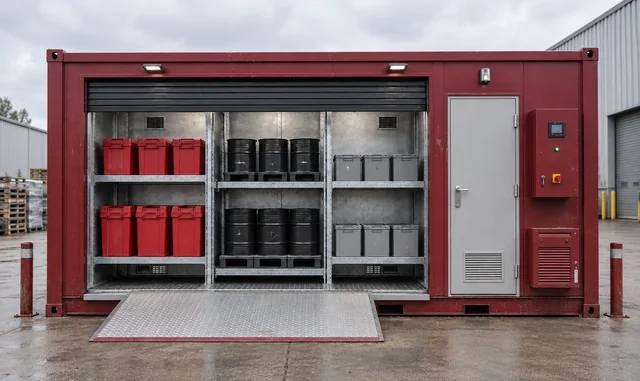
The containers placed inside the enclosure are important layout inputs. Record their external dimensions, handling arrangement and associated equipment information separately. Waste quantity and the space occupied by its packaging are different data. Explain the treatment of full and empty packaging through the facility's approved arrangements. This allows the manufacturer to evaluate a tangible layout rather than recommend an enclosure from an abstract total alone.
A photograph with no scale is less useful than an available dimensioned drawing or manufacturer information. Handles, wheels and projecting lids can affect the arrangement and should not be ignored. If the packaging may change later, describe that as a separate scenario. Mixing present and possible future inputs without distinction makes it difficult to identify which arrangement the quotation actually covers.
Keep capacity units separate
Treat area, volume, item count and load as different fields in the comparison. Geometrically fitting a number of packages does not automatically establish suitability for the associated load or operating arrangement. Those matters need coordinated technical assessment. The customer's role is to provide accurate inputs and understand the limits stated by the supplier. A broad claim of high capacity is not a comparable purchasing value.
Separate ordinary inventory from a peak scenario where the project team requires both. Record the operating assumptions behind the figures, and review them if collection arrangements change. This article does not prescribe storage periods or quantity limits. Its purpose is to keep specialist-defined information visible in the commercial process. Link the resulting dimensions, load statements and layout scope to the same approved revision.
Mark fittings as included, optional or excluded
Containment-related construction, shelving, partitions, ventilation, electrical equipment and monitoring may vary by project. Do not assume that every item is standard in every family. Ask suppliers to mark each item as included, separately optional or excluded. Clarify whether an option means preparation only or includes equipment and commissioning. The same word may describe different levels of completion in different offers.
Electrical preparation, for example, does not prove that a particular device is supplied. Ventilation should not be compared solely by counting fans before the technical approach is established. Specialists determine the necessary systems for the facility. The purchasing table makes the responsible decision-maker and the stage covered by the offer visible. It reduces the chance that an additional task is later disputed because one party assumed it was already included.
Connect performance language with a defined evidence scope
Terms such as fire-resistant, leak-tight or suitable for particular conditions need a technical context. Ask which complete assembly, conditions and supporting documentation the stated performance concerns. A component property is not automatically the performance of the finished container. Technical specialists should assess the relationship of doors, openings and service penetrations to the claimed scope. Purchasing staff should request that this relationship is clear in the project documents.
Do not transfer an unverified classification or duration into the brief as an established fact. If the requirement is undecided, identify it as a matter for assessment. A document title alone does not establish applicability to every model; specialists need to check the offered configuration against its scope. The aim is not paperwork for its own sake, but an understandable connection between the stated performance and the equipment being purchased.
Record site interfaces in a responsibility schedule
The boundary between the enclosure and the site is easily left unclear. Allocate responsibility for placement information, support arrangements, power interfaces, external equipment and access conditions. Identify whether the measurements are current. An old site photograph does not demonstrate that the location remains available today. Coordinate the parties responsible for the necessary technical reviews before treating the proposed position as confirmed.
For each task, the schedule can name the responsible party, expected information and approval stage. If a connection location must be verified before manufacturing, it should not first be discussed on delivery day. Show dependencies where production and site work rely on one another. This administrative arrangement does not replace technical design; it helps the designers receive the right information at the right time, particularly where several suppliers are involved.
Include maintenance access in the drawing request
The proposal drawing should show more than package positions. Include the access needed for the approved operating and maintenance arrangements. These areas should not be treated as whatever space remains after storage is maximized. Clarify who maintains the fitted equipment and supplies its documentation. The purchasing brief should recognize maintenance responsibilities without attempting to provide detailed intervention methods. Work in specialized waste areas follows the facility's authorized procedures.
Adding access requirements to the comparison reveals the consequences of different layouts. One option may show more package positions while another leaves clearer access to technical equipment. Price alone cannot decide whether that trade-off is acceptable; the relevant specialists should assess the operation. Naming the purpose of reserved areas on drawings also makes later changes easier to identify. Preserving the approved arrangement remains an operating responsibility.
Read two offers through a simple scope comparison
Imagine one offer including the enclosure, partitions and doors, while another also includes specified technical equipment, delivery and placement. Different totals do not immediately establish that one product is expensive. Extract the shared scope and list the additional tasks separately. Ask suppliers to explain differing assumptions. The exercise makes the difference visible rather than forcing dissimilar solutions into an apparently identical price comparison.
Where the scopes cannot be aligned, record why. One alternative may await a project assessment while another leaves particular work to the customer. Do not treat an unconfirmed task as having no cost. Identify who will complete it and what review remains necessary. This approach keeps the nature of the delivered work alongside the commercial amount, while the final purchasing decision remains subject to the relevant technical suitability assessment.
Link revisions to changes in the approved inputs
If package counts, dimensions or the intended stream change during the project, updating one table may be insufficient. Authorized personnel should review the consequences for the layout and technical scope. Record when the new information arrived and which drawing incorporates it. Circulating an old inventory beside a new plan can leave the manufacturer working from inconsistent assumptions. Revision control is therefore part of ordering the equipment, not merely an office convention.
Connect the requester, approver and resulting document. A spelling correction is different from a scope change, and the distinction should remain visible. Keep one current production reference. Later discussions should not become final instructions without being incorporated into it. The project record can then survive changes in personnel instead of depending on messages scattered among different people.
Agree acceptance criteria during the quotation stage
Do not wait until the unit arrives to decide what will be checked. Approved dimensions, equipment schedules, documentation and site-work boundaries can be identified in advance. Qualified specialists perform the relevant technical checks and tests. Purchasing personnel use the agreed list to track supplied items and records. An acceptable exterior appearance alone does not demonstrate that the technical scope has been completed.
Define how outstanding work is recorded and assigned. Ensure operating and maintenance information reaches the responsible staff. Decisions about waste acceptance or starting operation belong within the facility's authorized assessment; a product invoice does not replace them. The handover package preserves the relationship between the purchased equipment and the approved operating arrangement. It also provides a useful reference when maintenance or later changes are reviewed.
Separate verified, conditional and pending information
Not every input is equally certain. Some dimensions are verified, some equipment remains unselected and some requirements await specialist review. A status column makes these differences visible. Identify who verifies an unresolved item and when the answer is needed.
Ask the supplier to state the assumptions supporting a conditional offer. When information becomes firm, check the associated quotation and drawings. A preliminary value should not silently become the production dimension. The file matures as uncertainties are resolved, not simply as more documents are added.
Retain supplier clarifications with the relevant offer
Important explanations given during a call should be connected to the written scope. Record why an option is proposed, what is excluded and which inputs remain outstanding. Retain answers against the quotation and revision they concern.
Consolidate questions under clear headings rather than allowing several people to ask the same issue differently. Route technical and commercial questions to the appropriate specialists. An unanswered item should remain open. Reviewing that list before approval helps prevent an assumption overlooked during comparison from entering production as if it were confirmed.
Distinguish equipment delivery from site completion
Clarify whether delivery covers transport alone or also unloading and placement. This concerns moving the purchased equipment, not providing waste-transport services. Relevant professionals assess the product dimensions, approach and placement conditions. Agree when site preparation will be regarded as ready.
Where several parties work together, identify the sequence and contact responsible for coordination. External connections or equipment installation may follow placement. Exclusion from the manufacturer's quotation does not mean those tasks are unnecessary; it means another party owns them. Keep that distinction visible in the overall project budget.
Include operating stakeholders in the decision review
After technical assessment, review more than the lowest total. Operating, maintenance and technical representatives should see how the scope answers their requirements. Each contributes a different check, from documentation to connection boundaries or service responsibilities.
Record the selected alternative's rationale and remaining tasks. Do not confuse technical suitability with a commercial selection, or assume that placing the order automatically completes every operating decision. Assign the outstanding processes to their responsible people. Production can then begin against a defined scope rather than a list of tasks whose eventual owner is unknown.
Complete a concise, traceable enquiry package
A useful file need not be lengthy. Organize the project summary, specialist-approved waste information, packaging dimensions, site drawing, requested scope and unresolved questions into clear sections. Give documents dates and responsible contacts. Match the relevant Monte Grup families to those sections. Suppliers can then understand why an option is being considered and where their technical contribution is expected.
Before issuing the enquiry, ask whether two manufacturers reading it for the first time would understand the same task. If not, expose the missing assumptions. The customer does not need to complete every design decision; the purpose is to define the work that needs to be resolved. When the technical assessment, quotation and approved drawing remain consistent, comparison becomes more meaningful. The product name starts the discussion, while a clear scope provides the basis for the decision.